Meeting Of Fate
The world is ancient.
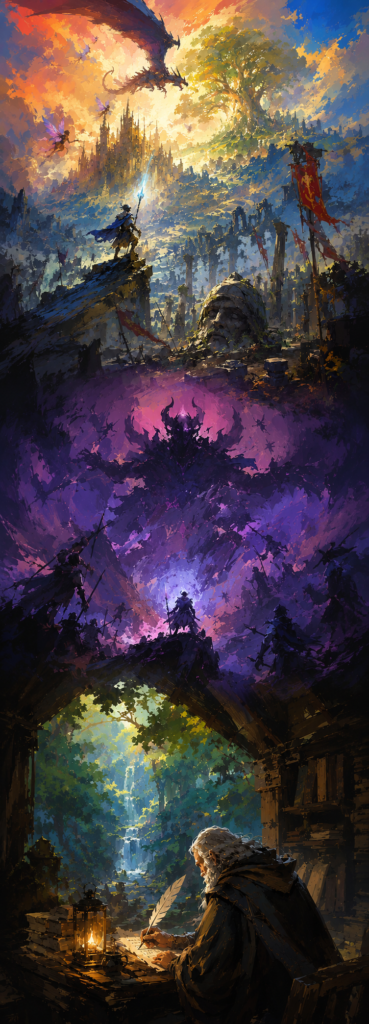
Once, it was a realm of unbridled magic and wonder, where dragons carved paths across the heavens and pixies drifted like living tides through enchanted groves. In those early days, the world was young—bright, unnamed, and unburdened. Many things were left to mystery, and life itself moved with an ease long forgotten.
But time is a patient force.
The weight of millennia has worn upon the world as a whetstone dulls a blade. Its brilliance has faded into whispers and half-remembered legends. Great kingdoms that once stood unshaken have crumbled, their ruins scattered like the bones of forgotten giants across the land. What remains is a world older, quieter, and far more cautious than it once was.
I remain.
I am a scribe of the old days, though such a title no longer carries honor. My duty, once revered, has become a solitary burden. My quill is now one of the last witnesses to the fading grandeur of the ages that came before. And before my own days are spent, there is one tale that must yet be told.
Let us recall greatness once more.
It is a tale of valor and might, of sorrow and despair, of mercy tested and honor upheld. It is the chronicle of one who, in his youth, rose to become the Kuza—the one and only—blessed with the power to wield magic and to stand against the darkness that ever seeks to devour the realm.
So let us begin, for the sands of time run low, and I, an old man, have little of it left.
Thus wrote Atlas, seated alone in his hidden cabin deep within the woods of Thafar. The quill in his hand danced across the parchment, etching memory into ink, and truth into legend.
It was the Year of Gulf, its ninth and final spring.
A cold wind swept through the land as Atlas set out toward the east, bound for the fabled and long-lost village of Ketbu. The morning was sharp and bright, and though Atlas was a powerful mage and seeker of ancient knowledge, the years weighed upon him more heavily than they once had.
From the Tuthra elves he had learned that Ketbu lay somewhere beyond the eastern hills, concealed by powerful enchantments—and perhaps even by dragons. Legends spoke of the village in hushed tones. Some claimed it drifted among the clouds, others that it guarded the resting place of a long-dead Kuza beneath the earth. Yet none could say for certain, for Ketbu revealed itself only to those it chose.
For many years Atlas had travelled in pursuit of knowledge, and though his will remained unbroken, weariness had crept into his spirit. His thoughts were ever drawn to the White Gem—the relic said to have belonged to the first Kuza. If it still existed, it was believed to possess the power to shift the balance of war by itself.
As Atlas climbed the hills of Drakia, the eastern lands unfolded before him in an unexpected beauty. Morning mist clung to the trees, turning the forest into a veil of silver and shadow. He paused, taken by surprise, and a faint smile touched his lips.
“Never could I have imagined the east to be so fair,” he murmured, the wind carrying his words away.
Descending into the valley beyond, Atlas found his breath stolen from him. Below lay a verdant oasis, fed by the glittering waters of a mighty river. Trees lined its banks, heavy with blossoms, and at the heart of the valley a great waterfall poured down in a cascade of crystal light. It was a place untouched by decay—hidden from maps and memory alike, sheltered by mountains and forest.
The valley below was dotted with small villages, nestled amongst the trees and along the river’s edge. Smoke rose gently from stone chimneys, drifting into the cool morning air, while the distant sound of laughter carried softly upon the wind. The people who dwelt there seemed to live in quiet harmony with the land, as though they belonged to it as naturally as the rivers and forests themselves.
A strange peace settled over Atlas as he looked upon the valley. For a brief moment, the burdens of the road felt distant.
Yet beneath that peace, something stirred.
As he descended toward one of the villages, Atlas began to sense a change in the flow of mana around him. At first it was subtle, little more than a faint disturbance in the air. But with every step, the current grew stronger. The mana of the surrounding lands was moving—slowly, steadily—toward the village hidden amongst the trees.
Atlas frowned.
Such a phenomenon should not have been possible, especially within a place so small and seemingly forgotten. He could feel the Arcane itself bending inward, as though drawn by an unseen force buried deep within the valley.
Curiosity soon overcame caution.
Though weary from his long travels, Atlas resolved to remain within the village for a time. Perhaps the people who lived there held answers. At the very least, the place offered shelter from the endless roads and restless years that had followed him across the realm.
Beyond the valley, the towering peaks of the Mountains of Drakia loomed beneath the pale morning sky, their ancient slopes half-veiled by drifting mist. Atlas walked onward through the dense woods, brushing past tall shrubs heavy with dew, while the distant sound of rushing water echoed through the trees.
Then the mana shifted once more.
This time, it was violent.
The energy within Atlas began to drain from him, slipping away as water escapes through open fingers. He staggered, struggling to maintain control over his own mana, but the force pulling at him only grew stronger.
His breathing became shallow.
The world swayed around him.
Then, without warning, the current reversed.
A tremendous surge of mana burst through the valley and crashed into him like a storm. The sheer force of it tore through his body and mind alike. Pain seared through his thoughts as though fire itself had entered his veins. His vision blurred. The trees twisted into shadow.
And then the world vanished into darkness.
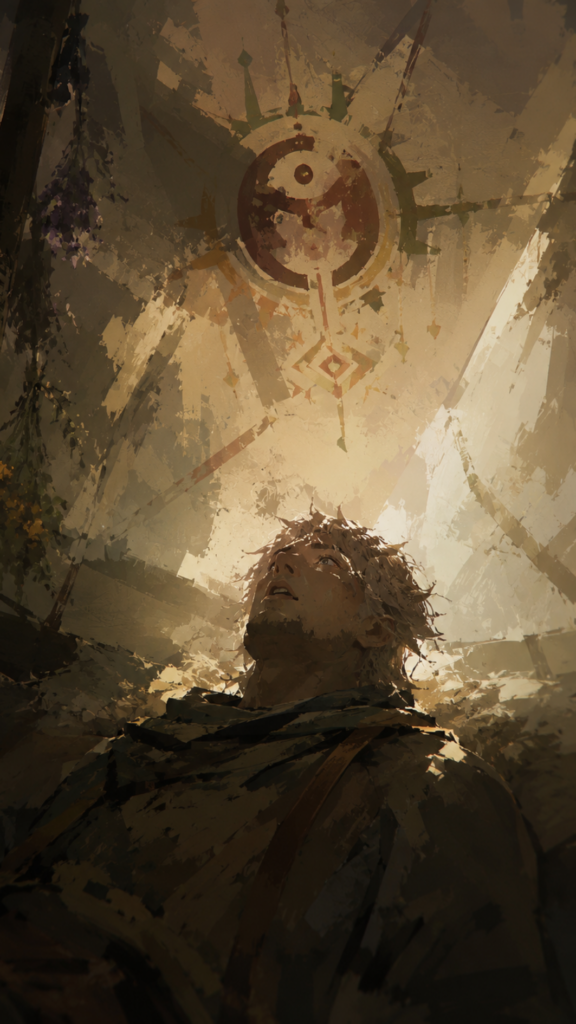
Atlas awoke to the scent of herbs and wildflowers.
For several moments he remained still, listening.
Beyond the canvas walls of the tent came the gentle murmur of a nearby river and the distant laughter of villagers beginning their day. Beneath him lay a bed of soft wool and hay, warm and strangely comforting, as though the earth itself had taken pity upon his weary body.
Is this a dream? he wondered.
His eyes slowly adjusted to the dim light within the shelter. Strange patterns and symbols had been stitched into the canvas walls—runes unlike any he had seen before. Though unfamiliar, they carried a quiet sense of power that lingered in the air around them.
Atlas closed his eyes briefly and turned his thoughts inward.
The mana within him had changed.
Only hours before, it had been unstable and violently torn from his grasp. Now it flowed calmly through him, steady and peaceful, as though soothed by unseen hands. Yet Atlas dared not draw too deeply from it. Whatever force existed within this valley was unlike anything he had encountered before.
As he gazed out from the open flap of the tent, he saw once more the distant peaks of the Mountains of Drakia rising beyond the morning mist. Sunlight danced faintly through the drifting fog, and for a moment the entire valley seemed suspended between dream and waking.
The memory of what had happened returned sharply to him—the shifting currents of mana, the unbearable pressure, the feeling of something ancient awakening beneath the land itself.
Just as Atlas lost himself within those thoughts, the tent flap stirred open.
An old man entered quietly.
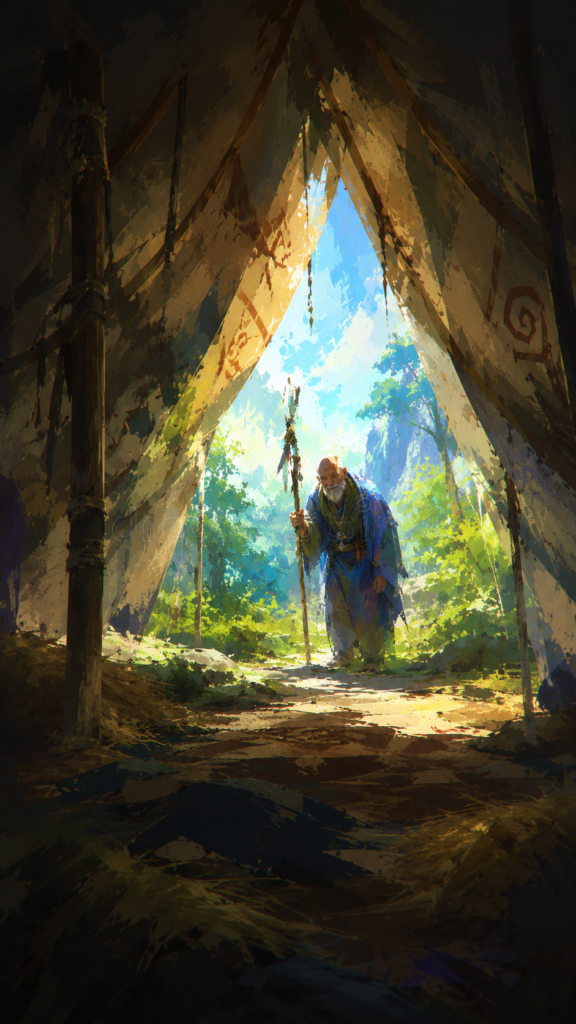
His face was weathered by age, and he leaned upon a wooden cane, yet there was warmth in his eyes and an unusual calm in his presence. The scent of herbs clung to his robes as he approached.
“Ah,” the old man said gently, “you are awake at last.”
Atlas pushed himself up slightly, though his body still ached.
“Do not strain yourself,” the man continued, his voice calm and soothing. “You gave us quite the fright, stranger.”
“Where am I?” Atlas asked, his throat dry.
“In our humble village,” the old man replied with a small smile. “Hidden deep within the woods, far from the troubles of the outer world. My name is Methra. I am a healer, of sorts.”
Atlas studied him carefully.
“We found you collapsed near the forest’s edge,” Methra continued. “The hunters came for me in great panic. They claimed you scarcely breathed, and stranger still—they could not lift you at first. It was as though the ground itself held you in place.”
Atlas lowered his gaze.
“My mana…” he murmured. “Something was drawing it away from me.”
Methra’s expression shifted ever so slightly, though whether from concern or recognition, Atlas could not tell.
“You should rest,” the old man said quietly. “There will be time enough for questions.”
Before leaving, Methra placed a bowl of warm boar Talbpat beside him, prepared by a woman named Mama Tamaya. Atlas thanked him sincerely, promising that the kindness shown to him would not be forgotten.
Yet even after Methra departed, Atlas’s thoughts remained troubled.
What power could twist mana to such an extent?
What force slept beneath this quiet village?
And why did the valley itself feel alive?
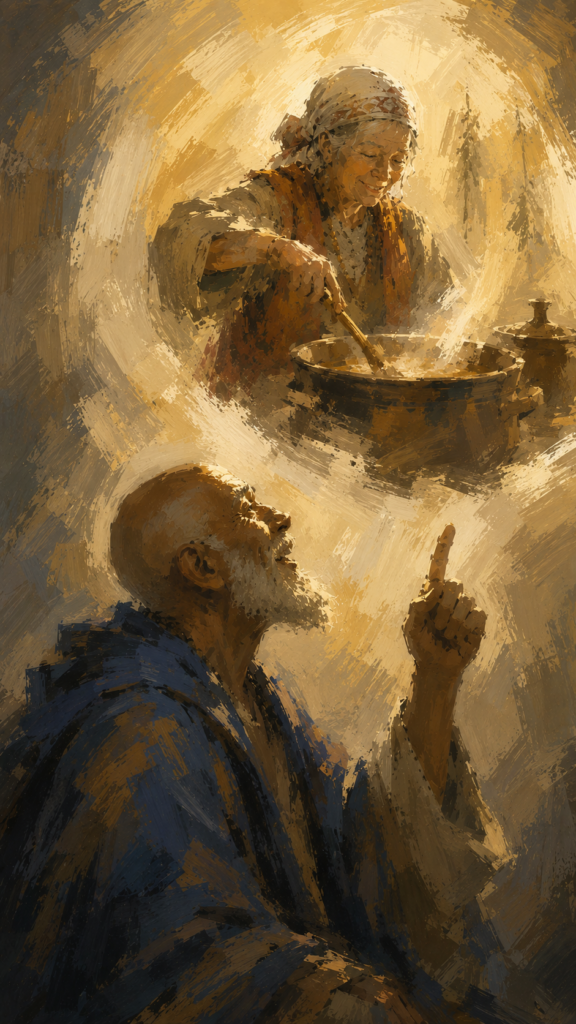
For a short while Atlas attempted to rest, yet peace would not come to him. Curiosity gnawed at his thoughts without mercy. Whatever he had felt within the valley was no ordinary magic. It was older. Deeper. Almost conscious.
At last, unable to remain still any longer, Atlas rose and stepped beyond the tent.
The sight before him filled him with quiet wonder.
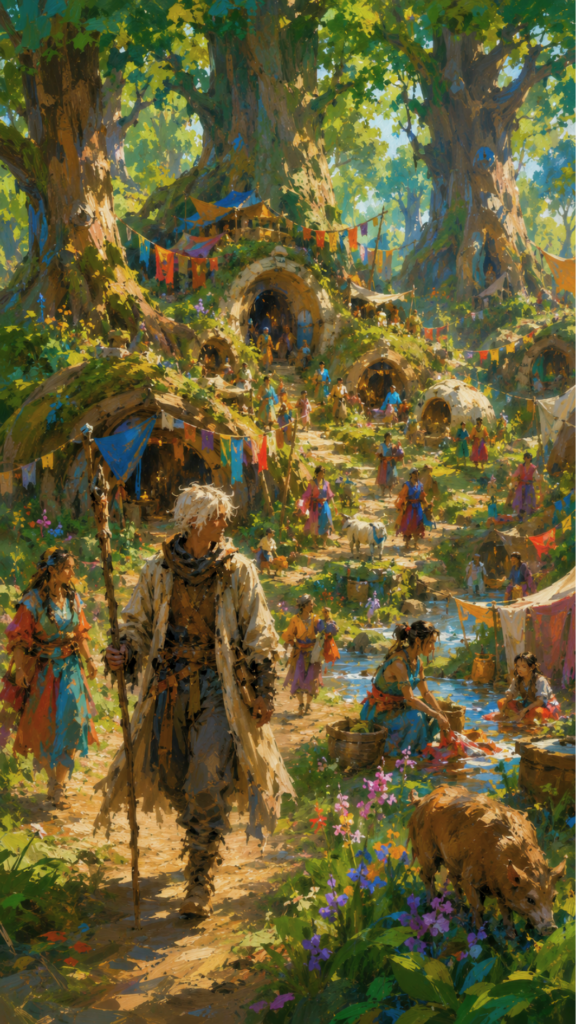
The village seemed less like a settlement and more like a forgotten fragment of another age. Wooden homes stood beside caves carved directly into the mountainside, their entrances adorned with delicate carvings and ancient symbols. Stone paths wound between tall green trees whose branches were wrapped in flowering vines.
Life stirred everywhere.
Women knelt beside the river washing garments while laughter echoed between the houses. On the far side of the water, men carved timber into finely crafted tools and ornaments. Children raced through the streets in playful chaos while shepherds guided their animals through the surrounding jungle hills.
Atlas wandered deeper into the village, observing quietly.
The architecture blended so naturally with the land that it often seemed grown rather than built. Homes of clay and stone rested beneath the shade of ancient trees, shaped carefully to preserve the beauty of the valley rather than conquer it.
Everywhere he looked, symbols of the natural world revealed themselves—sun and moon carvings etched into doorways, stars painted upon wooden beams, flowers woven into hanging charms. The village felt bound to nature in a way Atlas had never witnessed before.
And stranger still, he felt no hostility from its people.
The villagers greeted him warmly as he passed, offering smiles and gentle nods despite knowing nothing of him. Atlas, who had spent much of his life wandering amongst suspicion and ruin, found the feeling deeply unfamiliar.
For the first time in many years, he felt as though he had arrived somewhere he was meant to be.