A New journey
As the first light of dawn approached, the people of the hamlet hurried toward Ferradun’s hut, where Parritha struggled to bring forth her firstborn child. It was a rare and wondrous moment, heavy with fear, hope, and waiting. Ferradun stood with pride burning in his chest, and so did we all, when the cry of a healthy child rose from within the small hut and echoed through the village.
“Tonight, the child will be named before our people,” Methra said with a gentle chuckle. “He will be welcomed into the village and placed beneath the blessing of the Guardian of Night. I ask you to join us, unless your quest calls you elsewhere, or unless you still chase after Alva. Believe me when I say this night will be remembered for many years. New life is no small blessing, and it would honour us to have you present for such a day.”
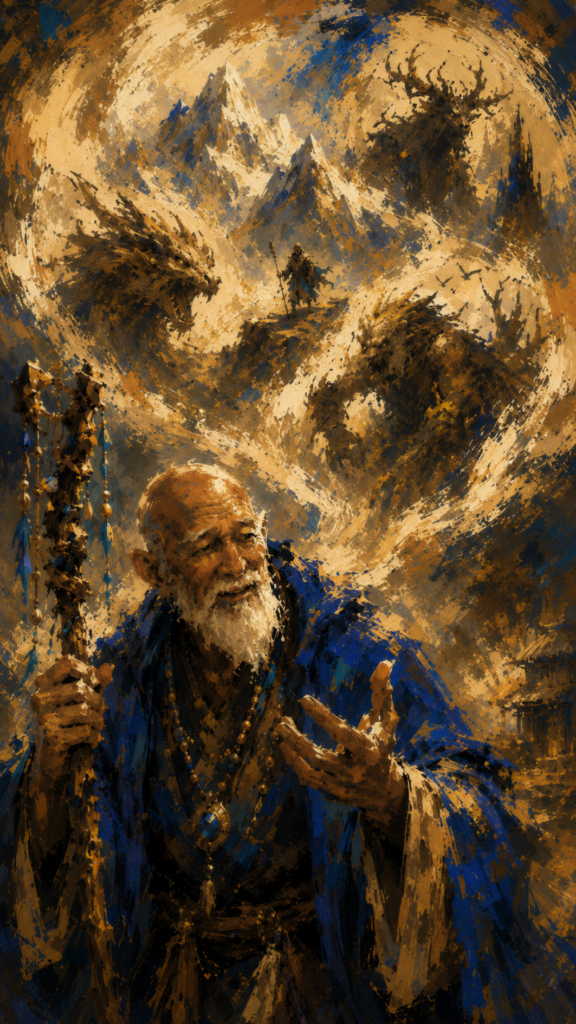
“As the first rays of light crossed the hills, the hunters returned to the village in great commotion. And there you were, in a strange state indeed, breathing hard, pale of face, and with your heart racing faster than any horse in the land. We gave you calming herbs and told you to rest, for it was clear that fear had taken hold of you.
“Yet look at you now. Your strength has returned. You stand on your own feet again after only half a day of rest. The body can be a stubborn thing, and the spirit more stubborn still. But take care, my friend. Do not walk again into the unknown without caution, for the world is wide, and its dangers are many.”
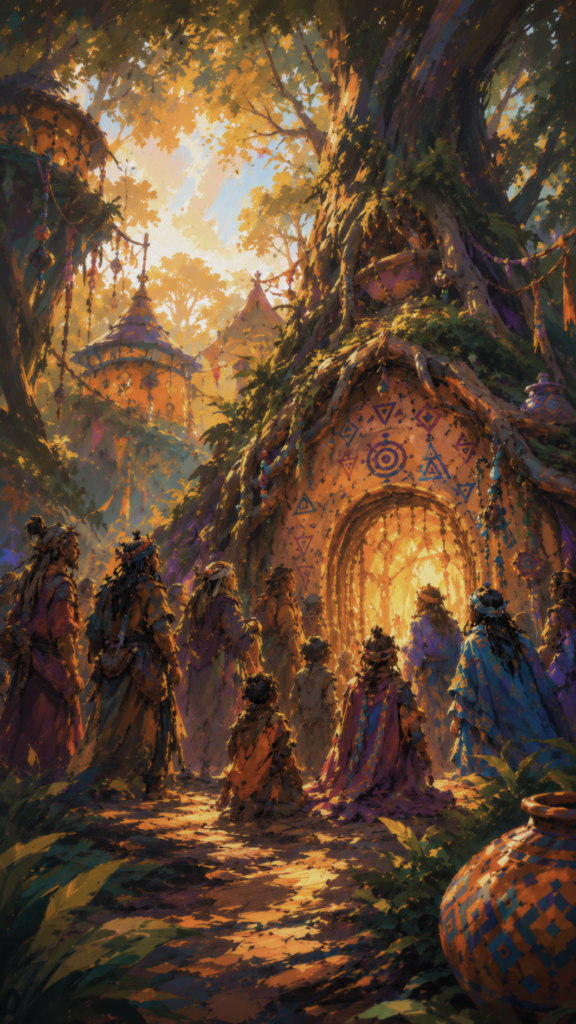
So Methra spoke to his companion as they sat together and drank their tea.
There was honesty in his welcome, and Atlas could feel that the old man truly wished to ease him. Yet there was also caution in Methra’s tone, as though he knew the matter was delicate and that one careless word might trouble the peace between them. Still, his kindness could not be mistaken. Atlas felt warmth in his company, even as he knew that not all truth could be spoken.
“As I crossed the rolling hills,” Atlas said, his voice calm, though his face held a guarded look, “my eyes were drawn to the beauty of this land. The trees, the slopes, and the quiet of it all held me for a time. Then I saw your village. The journey had worn me down, and my hunger had grown so fierce it felt as though it would swallow me whole. My strength failed me, and I stumbled before I could reach the first huts.
“What followed is unclear to me. It is only a blur in my mind. I remember voices, hands lifting me, the taste of herbs, and the smell of warm food. Yet I will not forget the kindness of those who tended to me when I had no strength left. It is a humbling thing to be left at the mercy of fate and strangers. But such is the way of this world, where fortune can turn as quickly as the wind over the hills.”
These were the words spoken by Atlas, though his face remained touched by secrecy. He wished to show gratitude, but he also wished to keep his true purpose hidden from those around him.
“It is a wondrous and dangerous world we live in,” Methra said. “It is full of mysteries and marvels beyond the reach of common thought. Yet every path into the unknown carries the risk of danger beyond our reckoning. It takes courage to leave the comfort of one’s home and walk into lands unseen, but such is the way of travellers and seekers of knowledge.
“You came from beyond the mountains, from a place our people have not dared to cross. Tell me, what lies beyond those peaks? Does much happen in that realm? We have heard tales of chaos brought by monstrous beasts, yet we have never passed beyond these green wilds or strayed far from our hidden village.”
Methra spoke with the wisdom of those who had come before him, his eyes bright with quiet curiosity. His words carried the weight of old memories and the hope of those yet to come. In his voice lived the echo of ancient knowledge, and also the restless wonder of one who still wished to understand the world. He was a rare soul among his people, shaped by age, patience, and a mind that had not grown dull with time.
As they continued speaking, the small village opened before them. Huts made from clay, timber, leaves, and woven grass stood along the slope, their low roofs casting long shadows beneath the setting sun. Smoke rose from cooking fires. The smell of fresh food drifted through the air, while joyful voices and the laughter of children moved with the evening breeze.
In the distance, the riverbed glistened under the fading light, shining like scattered stones of silver and gold. Its gentle rush brought peace to the ear. Freed for a short time from chores and work, the children played near the shallow water, laughing, splashing, and running barefoot along the bank.
As Methra and Atlas joined the gathering, they felt the warmth and closeness of the village. Yet not all welcomed Atlas. Some of the people kept their distance, watching him from beside fires, doorways, and the shadows of their huts. Their glances were brief, but not hidden well enough. A stranger in such a place was no small matter.
When Ferradun and Parritha arrived, a respectful hush fell over the people. The singing softened, and the steady beat of lute and drum carried across the water. Ferradun walked with care, holding the child close, while Parritha stood beside him, weary from birth yet calm in spirit. The people made space for them near the river, and the joy of the gathering settled into quiet reverence.
Ferradun took a deep breath. His heart overflowed with pride and love as he looked to his wife, then to the child in his arms. He raised his voice before the gathered people.
“Herben.”
As he spoke the name, his hand gently touched the head of his newborn son.
At once, the village burst into joyful sound. The people cried out, laughed, sang, and moved closer. One by one, they surrounded little Herben and his parents, forming a circle by the river. Some embraced Ferradun. Some placed their hands over their hearts. Others sang the old songs that had been passed down through the hidden village.
As they congratulated Ferradun and Parritha, the villagers drew together around the family. They closed their eyes, clasped their hands, and bowed their heads in prayer to the Guardian of Night. They asked that the child be blessed with health, long life, and a future free from hunger, sickness, and fear. Their voices rose as one, creating a soft and solemn melody that seemed to travel over the river and into the darkening hills.
The feast continued long into the night, with laughter and song filling the air. Food was passed from hand to hand, stories were shared beside the fires, and for a while the burdens of the world beyond the hills felt far away. As the night wore on, one by one, the villagers returned to their small huts, content and grateful for the blessing of the day.
When the night grew darker and the people slowly disappeared into their homes, Methra shuffled back toward his hut with a tired step, needing the rest that age often demands. Atlas, however, stayed a little longer. He stood beneath the open sky, taking in the silence of the village and the stars shining above.
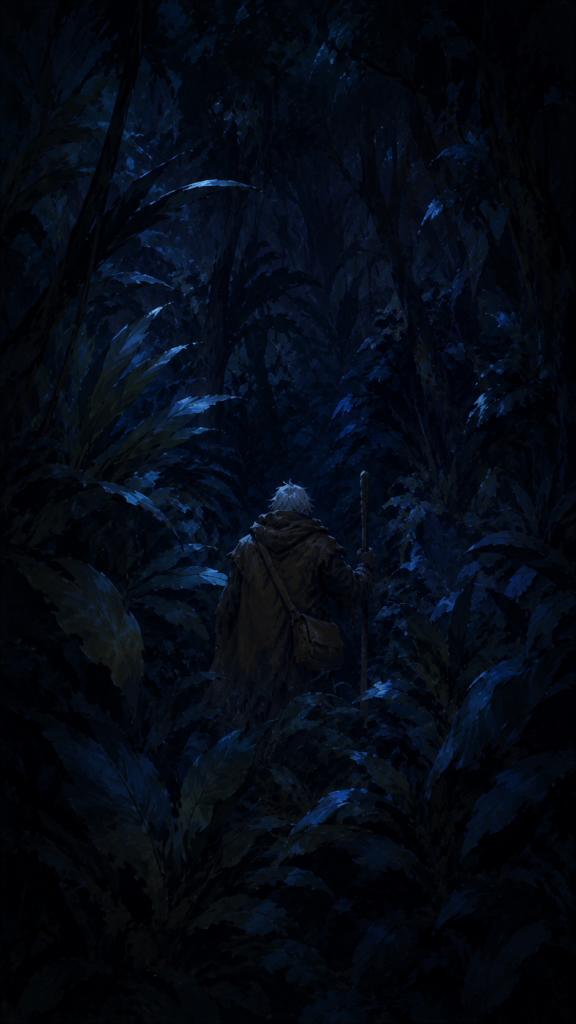
A warm bed would have been welcome, but Atlas knew his path was not finished. The disturbance in the mana flow still troubled his thoughts, yet he knew better than to press too deeply into the affairs of the people around him. He had a more urgent purpose in mind: to find the hidden village of Ketbu and uncover its secrets.
It seemed that some of his questions had been answered, but not all. With a steady spirit, Atlas turned away from the fading fires and set off into the darkness once more, climbing the eastern hill in search of the white gem. His eyes adjusted to the shadows, and his feet carried him onward with careful strength. Though the night was still, the rustling of leaves and the chirping of insects filled the silence around him.
As he journeyed deeper into the night, Atlas wondered what dangers waited ahead. Yet his resolve did not weaken. He continued his search with clear purpose, determined to uncover the secrets hidden in the dark.
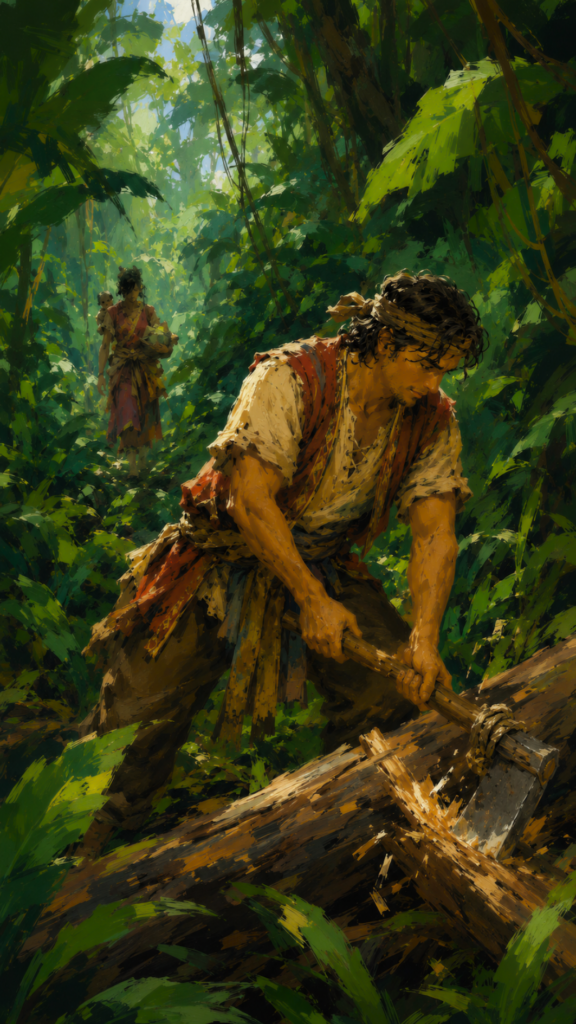
In the land of Daikan, there lived a man known for his strength and good heart. Ferradun was no lord, nor a man of riches. He owned no great hall and commanded no servants. He was a farmer, a builder, a gatherer, and, when needed, a protector of his people. Through his labour, the land gave fruit, and the village was fed.
It was said that Ferradun had the strength of many men and the courage of a lion. His hands were rough from soil and stone, and his back had been shaped by long days beneath the sun. Yet his strength was not what made the people love him most. It was his generosity, his patience, and the kindness with which he carried the burdens of others.
Ferradun’s virtues were not found only in the fields. He was a humble man, simple in his ways, and not given to pride or needless speech. His faith in hard work was strong, but stronger still was his love and devotion to his wife, Parritha.
Parritha was a woman of wisdom and grace. Her calm manner and sharp mind had earned the respect of many in the village. She was known as one who could guide troubled hearts, and her counsel had helped many endure the trials and sorrows of life. Through her, Ferradun had learned to tend not only the soil beneath his feet, but also the spirit within himself.
And now, as the couple welcomed their firstborn son into the world, the people of Daikan rejoiced. They believed the child would be a blessing to them all, a sign that hope still lived among their hidden people. So they gathered around Ferradun and Parritha, offering their joy, their prayers, and their blessings, asking that Herben grow strong, wise, and just, and that his life become a witness to love and hope in the face of hardship.
The sun’s rays shone down on the village, lighting the riverbank where the women had gathered to wash clothes and clay bowls. futara, a wise elder among them, spoke with a calm and measured voice, her words carrying the weight of long years.
“Parritha has been a mercy to this village since the day she came,” futara said, her eyes turning toward her. “And now her son may become a blessing for us all.”
The other women nodded in agreement, their hands busy scrubbing and rinsing cloth in the clear river water. The sound of the rushing stream mixed with their gentle talk, creating a peaceful mood beneath the morning light.
Then a cry broke the calm.
Parritha turned toward the sound at once, concern clear upon her face. She excused herself from the group and stepped away from the riverbank.
“You are kind to say such things,” Parritha said, her voice soft, “but I must go to him.”
She walked toward Herben, who was crying near the shade of the huts.
The other women watched her leave, their curiosity stirred. There was something mysterious about Parritha, something that set her apart from the rest of the village. They could not name it, but they felt it. There was more to her than what appeared on the surface.
As Parritha tended to Herben and soothed his tears, the women could not help but wonder what secrets lay hidden behind her kind and gentle face. Perhaps there was more to this woman than anyone had imagined. And perhaps, one day, the mysteries around her would be revealed.
Years passed in a blur, and Herben grew into a sturdy and gifted young boy. His talents became the talk of the village, and many parents had already begun to wonder whether their daughters might one day be joined to him. Ferradun, his father, would only shake his head and say the boy was too young for such talk. Yet, as all in the village knew, such matters were never truly decided by Ferradun alone, but by Parritha.
From a young age, Herben could speak the three tongues of Men, Elves, and Dwarves. By the age of four, he had grown strong enough to carry water from the river, a task that even grown folk found heavy, and he helped with many chores around the hut. Yet strength was not the thing that drove him most. His hunger was for knowledge, and above all, for the strange book his mother kept hidden from him. Parritha, with stern love, would forbid him from touching it, and at times, when he pushed too far, she would strike his hand and turn him away.
Still, for all her sternness, Parritha was a loving mother. She filled Herben’s mind with stories of distant cities, strange beings, old kingdoms, sacred houses, and shining palaces that lay far beyond the western horizon.
When Parritha became pregnant with another child, Herben cared for her with a devotion far beyond his years. He would wander into the jungle and climb the lower mountains to gather herbs, roots, and whatever small creatures could be hunted for food. Each sunrise, he would stand in silence and watch the light slowly chase away the shadows, as though the world itself were waking from a deep sleep. He would gaze toward the mountains beyond the village and wonder what rested on the other side. Perhaps golden halls, high stone towers, and many peoples with customs, songs, and knowledge he had never known.
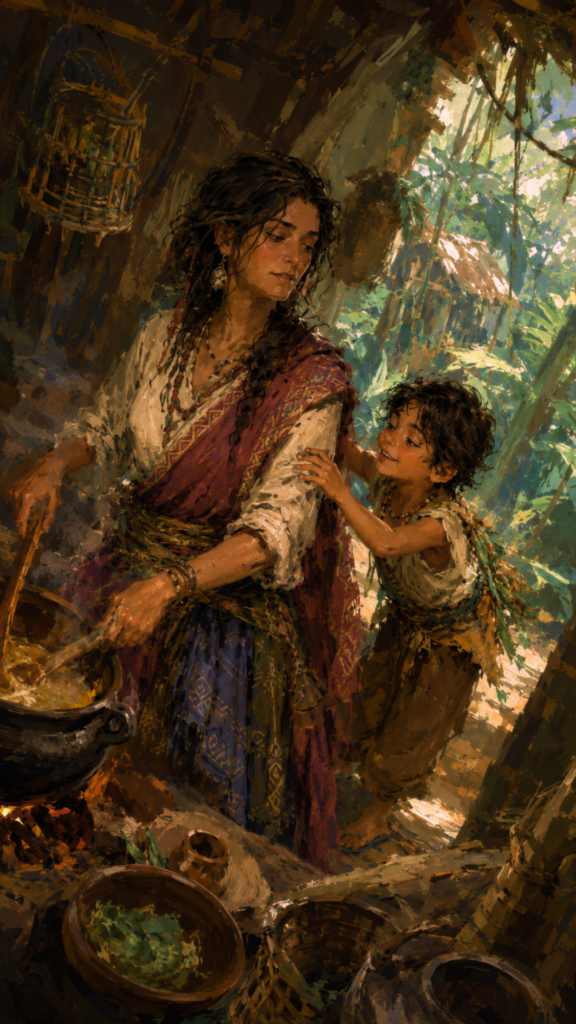
After each small journey, Herben returned home with his gatherings held close, eager to show his parents how much he had grown. He would wait for them to rise, smiling with pride as they looked upon what he had brought. At times, Parritha would weep and pull him into her arms, while Ferradun would laugh and call him his little jallaka, a name used in their village for a pure and fair little devil.
As Herben grew, so too did his curiosity. The world, he felt, was full of hidden truths and wonders waiting beyond the trees, beyond the hills, and beyond the stories of the elders. He wished to know them all. He did not yet understand that this hunger for discovery would one day carry him farther than any dream his young heart could hold.
Parritha knew this hunger well, and though she guarded him, she also fed his mind. She spoke to him of the fabled land of Arcanath, where distant cities rose beneath strange skies, where magical beings walked beside men, and where wonders slept in places no villager from the hidden hills had ever seen.
She told him of cities made from crystal and ice, their towers reaching toward the heavens like jewels carved by careful hands. In those places, she said, many kinds of beings lived beside one another, held together by the Art that moved through the world like an unseen breath.
She spoke also of hidden cities deep within the forests of the elves, where ancient trees bent and twisted into homes, bridges, and quiet sanctuaries. There, the leaves whispered with memory, and the roots held secrets older than the kingdoms of men.
Then there was Nexorionel, now called Nexadell, the great meeting place of the world. It was said that the strongest mages from many lands gathered there to study, test, and teach one another. Its buildings shone with a pale light, and the air trembled with Arcane Art and Arora, as though the very stones had learned to breathe.
Across those lands, Parritha said, lived many creatures, some gentle and some fierce, each with their own ways and laws. There were dwarves who had carved vast halls beneath the mountains, where gem-light and metal-fire glimmered in the deep. There were also the merfolk, who lived in the underwater cities of Nerethale and Selthavor, where their Art allowed them to move and thrive beneath the great waters.
Parritha spoke of Arcane users as well, those who could touch the forces hidden in nature. Some breathed fire. Some bent earth and air. Some healed sickness and wounds with their hands. Others called upon beasts, not through chains or whips, but through old bonds woven between spirit and flesh.
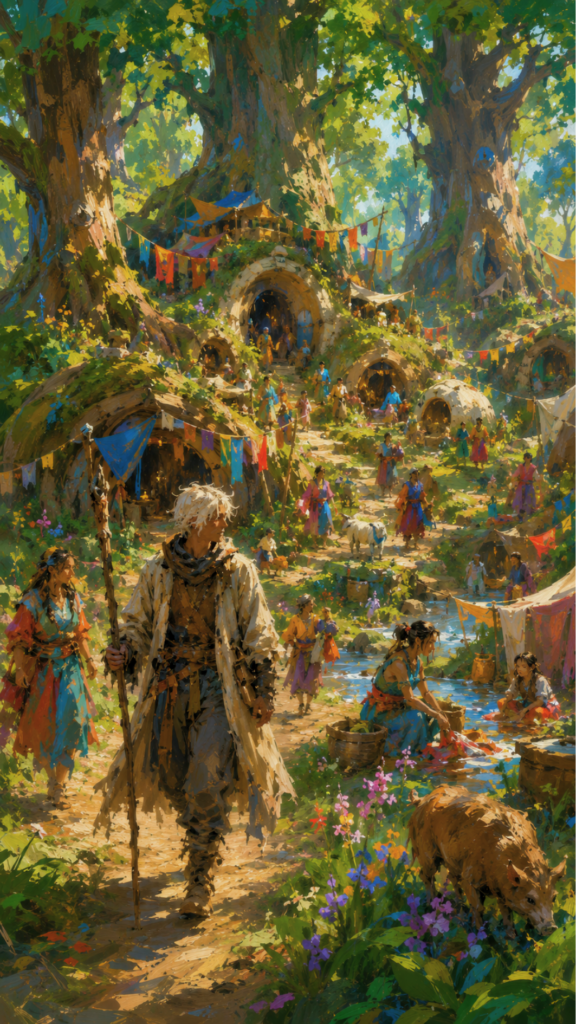
In the world of Arcanath, there was always another mystery, another wonder, another door waiting to be opened. To Herben, it sounded like a world shaped from dreams.
As Parritha spoke, other images would rise in his mind. Great dragons crossing the sky, breathing Arora and beating their wings against the clouds. Deep forests where light moved like water. Silent towers where old mages watched the stars. Roads that led into lands no one in his village had ever walked.
Herben’s mind would race as he listened. He imagined himself entering hidden cities, standing before dragons, learning the Art, and mastering the strange powers his mother spoke of. For now, however, he remained a child of the hidden village. He gathered herbs, hunted for food, carried water, and dreamed of the day when he might step beyond the hills and seek the world with his own eyes.
Though young, Herben showed a strength of heart rare among children. He often found comfort in the stories and teachings of his mother, more than in the company of the other children. Parritha’s presence soothed him. Her words fed his hunger to learn, and her voice gave shape to the great unknown that waited beyond the village.
While the other boys wrestled, shouted, and played rough games in the dust, Herben spent much of his time learning letters, tracing old marks, and taking part in quiet tasks that suited his nature. He was spirited, but not careless. He had a strong heart, yet he carried a depth of feeling that often made him seem older than his years.
It was during his sixth spring, as the sun sank in a blaze of gold behind the mountains, that Herben waited for news of his newborn sibling. He stood outside the sacred house, a place built from stone, clay, and packed earth, set into the side of the mountain. His chest tightened with nervous joy as he waited for someone to come and tell him that the child had arrived safely.
Parritha had been carried there with care, for her first child had come a month too early, and the healers feared the same danger might return. The sacred house rose in a box-like shape against the mountain, built in levels, with a narrow stair curling upward toward its higher rooms. Inside, cool shadows rested upon the walls, and strange creatures moved softly through the halls.
Herben had seen them before, though never so close. They were small, furred beings with watchful eyes and warm bodies, gentle in manner and strange in spirit. The elders said they carried healing within them, a gift beyond the skill of ordinary men. Some whispered that they were favoured by the gods, and that good fortune followed those who were allowed to sit near them.
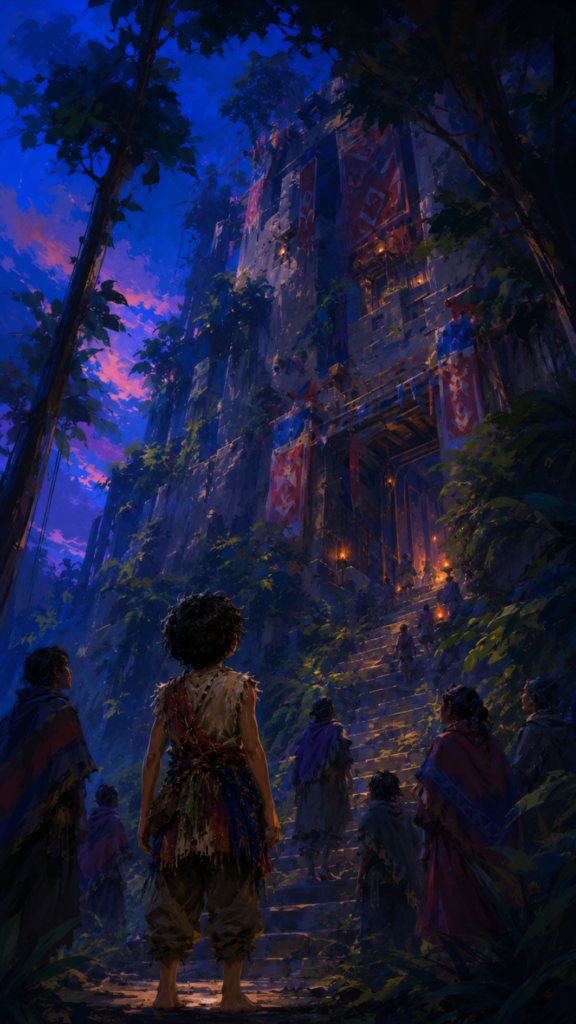
In that quiet place, Herben waited with his heart full of hope and fear. The air seemed thick with the weight of new life. Every small sound made him lift his head. Every footstep made him think the news had come.
Nervousness soon overcame him. He shut his eyes and tried to steady his breathing. Beneath his bare feet, he felt the pull of Arora moving through the stone and earth, drawing him toward the inner rooms of the sacred house. Yet those rooms were forbidden to all except the trusted healers and mages. The energy called to him like a low voice beneath the ground, but Herben held himself still. He would not enter where he had been told not to go.
Slowly, the restless force within him began to settle, though a thin anger remained beneath it, hidden and pressed down.
When Herben opened his eyes, he saw his father running toward him.
Ferradun did not speak. He seized Herben in his arms and hurried back toward the sacred house, his face set hard and his fury barely held beneath the surface. When they reached the inner room, he placed Herben beside his mother. The chamber was full of silent watchers pressed close to the walls. No one moved. No one dared speak above a whisper. Ferradun stood near Parritha, holding her hand as though his strength alone could keep her bound to the world.
The healers murmured prayers under their breath.
“May the grace of Arcanath be upon us. This day carries danger, and the path before us is uncertain. Arora rises and falls like a wild tide. We hold to faith, and to the hands of those who heal. Let the child come safely into the light, and let mother and child remain under the protection of Arcanath.”
Their voices were soft, but fear clung to every word.
Herben stepped into the dim room where his mother lay upon a bed of furs. Pain marked her face, and tears shone upon her cheeks. He moved toward her with careful steps, feeling the heaviness of the moment though he could not understand it fully.
Parritha’s breath came shallow and hard. She lifted a frail hand and called him closer. Herben leaned down, his small face near hers, trying to catch her words.
“Herben, my brave boy,” she whispered. “Listen to me.”
Her voice was thin, but her eyes held him with fierce love.
“You are strong. Stronger than you know. But I fear for your father. He may look strong from the outside, yet inside he is soft and breakable, like a newborn fawn. Care for him.”
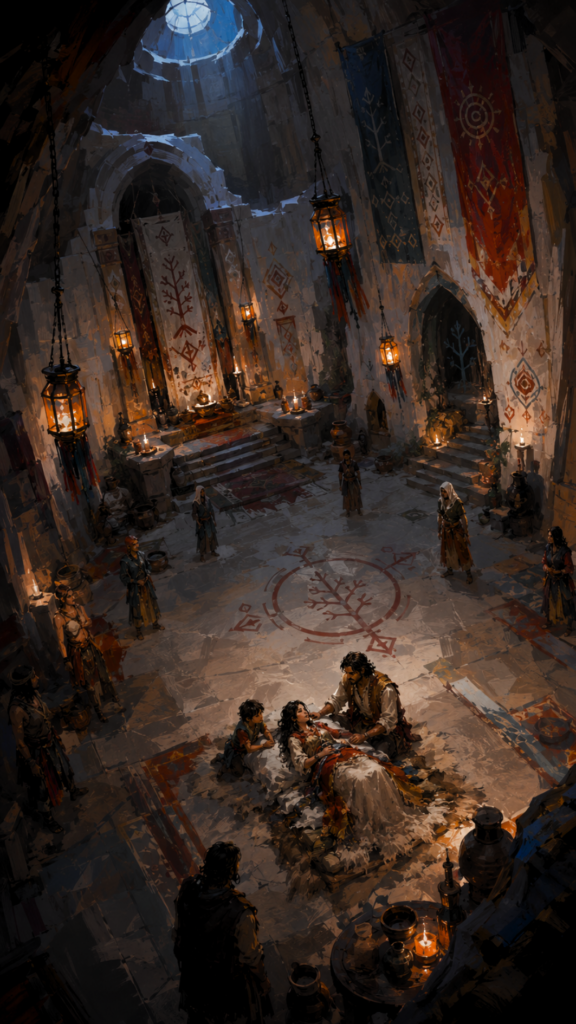
Tears gathered in Herben’s eyes. He fought to hold them back. His father had always seemed unshakable, the one who carried every burden, the one whose hands could lift stone and whose back never bent before work. Herben had never thought that such strength could hide pain.
“Herben, my son,” Parritha said, her voice weakening. “I do not have much time left.”
Herben’s heart sank. His thoughts scattered, and fear rose in him like cold water.
“Mother, what is happening?” he asked, his voice trembling. “Is everything all right? Did I do something wrong again?”
Parritha reached for his hand. Her grip was weak, but she held him with what strength remained.
“No, my sweet boy. It is not you. Never think that. I have fallen ill, and my time here is coming to an end.”
Ferradun, who had stood near the doorway in silence, stepped forward.
“Listen, Herben,” he said, though his voice broke as he spoke.
Herben nodded, still too young to bear the full weight of what he was hearing, yet old enough to know that something terrible had entered the room.
“Take him with you, Herben,” Parritha continued. “Follow the One. Together, you must seek the truth of this realm, and the fate that waits for us all.”
Herben nodded again, though his throat had tightened so much he could hardly breathe. He took his father’s hand, feeling it tremble in his own.
Parritha looked at them both. Her voice shook as she spoke to her son.
“My dearest Herben, I love you more than words can hold. Take care of your father, my sweet boy. He needs you now more than ever. You are both the light of my life, and the thought of leaving you fills me with sorrow.”
Herben could no longer stop his tears. They ran freely as he listened to her. He could not imagine the world without his mother in it. He held her hand with both of his, feeling the warmth of her skin, trying to remember every line of her face, every breath, every small movement, as though memory alone could keep her with him.
Parritha continued, her voice growing weaker by the moment, “Promise me that you will be strong, my dear son. Don’t be too sad when I am gone. Remember that I will always be with you, in your hearts. And if ever you need me, just feel your heart, your tiny tuni heart, and I will be there with you.”
Herben’s heart ached with sadness as he listened to his mother’s words. He wanted to beg her to stay, to cling to her and never let her go. But he knew that he couldn’t stop what was happening. He felt powerless and small in the face of this great loss.

Parritha closed her eyes, her breathing slowing down, “I am so grateful for the time we have had together, my dear family. You have brought me so much joy and happiness. I am at peace now, knowing that I will always be a part of you. Promise me that you will take care of each other, and that you will always remember me.”
Herben and Ferradun both nodded, tears streaming down their faces. They held onto Parritha’s hands as she took her last breath, feeling the life slip away from her body.
The room was filled with a profound silence, broken only by the soft sound of Herben’s sobs. Together, they stood at Parritha’s bedside, watching as the light slowly faded from her eyes. Herben could feel the tears welling up in his eyes. “I promise, Mom,” he said, his voice barely above a whisper.
With a final gasp, she drew her last breath, and the room was filled with a deep silence. Herben and Ferradun stood in stunned silence, their hearts heavy with grief and the weight of the task ahead.
As the night went on, the darkness seemed to swallow Herben whole. He was but a young child, innocent and naive, and the concept of death was something he could hardly comprehend. Yet, deep down, he knew that he would never see his mother again. The thought alone was enough to send him spiraling into a state of confusion and despair.
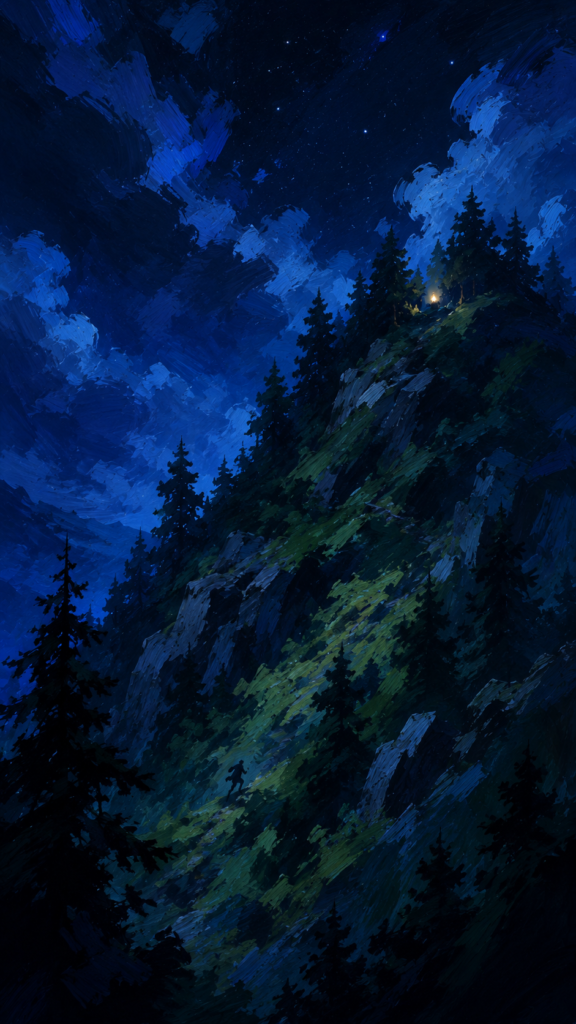
Driven by an overwhelming sense of loss and grief, Herben fled into the jungle and climbed up into the mountains. There, perched on the edge of a precipice, he gazed out at the stars and the moon, still grappling with the enormity of what had just happened.
The weight of his mother’s words hung heavy upon him, and he struggled to make sense of them. His heart pounded in his chest, and his body shook with emotion. But then, as if by some unknown force, he was suddenly overcome with a sense of calm. It was as if the very earth beneath him was pulling him down, urging him to rest.
As he succumbed to the lull of the earth’s embrace, his eyes grew heavy and his body relaxed. It was as if he was being gently guided to a place of peace and comfort, where he could forget his sorrows and drift off into a deep, dreamless sleep.
With eyes that saw beyond the mortal realm, Herben had visions that he could scarcely remember upon his return to the waking world. All that remained was the echo of his mother’s voice, urging him to soar to great heights. And when he awoke, he found himself suspended in mid-air, his body hovering effortlessly a meter above the ground.
He sat cross-legged, his arms outstretched, and his eyes a deep, abyssal black, studded with twinkling stars. And from within his chest emanated a soft, pulsating light, a dim but steady glow that seemed to radiate with an otherworldly energy.
It was a sight to behold, and one that filled Herben with both wonder and fear. What power lay within him, and what purpose did it serve? Only time would reveal the answers to these questions, but for now, he knew that he was destined for greatness, whether he was ready for it or not.
Ferradun trekked up the mountain slowly, his breaths ragged and laboured. Suddenly, he called out with a voice that seemed to carry the weight of the world, “Herben!” The boy, lost in his thoughts, lost his focus, and tumbled to the ground. Ferradun approached him with a haunted look, as if he had just seen a ghost. “So it was true, you are the one,” he muttered to himself, hardly able to speak as his voice shook with emotion.
Herben struggled to rise to his feet, fear creeping into his heart. But before he could utter a word, his father enveloped him in a tight embrace and began to weep uncontrollably while repeatedly mumbling “you are him, she was right, your mother was right”. Herben could feel his father’s chest heaving with sobs, and for a moment it seemed like everything was about to be worse. But then Ferradun spoke, his voice shaking with emotion as he addressed his son saying …